Swallow a probiotic capsule and most of the bacteria inside it are dead within hours of reaching your stomach. Acid, bile, and a hostile resident microbiome see to that. Yet the same person who spends forty dollars a month on those capsules will walk past the one thing that actually feeds the bacteria already living in their gut — a head of garlic, a bag of oats, a cold boiled potato. This is the strange asymmetry at the center of gut health: we obsess over adding new bacteria and almost completely ignore the question of whether the bacteria we already have are being fed.
Probiotics and prebiotics get mentioned in the same breath so often that most people assume they are two words for the same idea. They are not. One is a living organism. The other is a type of fiber those organisms eat. Confusing them is not a trivial vocabulary slip — it is the reason so many people take probiotics for months, feel nothing, and conclude their gut is simply broken. The bacteria arrived, found nothing to eat, and left.
What follows is the actual difference, why both matter, and how to tell — for your specific situation — whether you need to add bacteria, feed the ones you have, or do both. By the end you will be able to read a supplement label and know within seconds whether it is worth your money.
The Core Difference, in One Sentence Each
A probiotic is a live microorganism that, taken in adequate amounts, confers a health benefit. That is the formal definition the field has settled on, and every word in it carries weight. Live — a dead bacterium is not a probiotic. Adequate amounts — a sprinkle is marketing, not medicine. Confers a benefit — the strain has to actually do something measurable, not merely survive the trip. When you eat yogurt, drink kefir, or swallow a capsule labeled with strain names like Lactobacillus rhamnosus GG, you are consuming probiotics: outside bacteria you are introducing into your system.
A prebiotic is something entirely different. It is a compound — almost always a type of fiber — that your own body cannot digest but your gut bacteria can. You eat it, it passes untouched through your stomach and small intestine, and it arrives in your large intestine where your resident microbes fall on it like a feast. Garlic, onions, leeks, asparagus, oats, slightly green bananas, and cooled cooked potatoes are all rich in prebiotic fiber. You are not adding bacteria when you eat them. You are providing fuel for the bacteria already there.
The simplest way to hold the distinction: probiotics are the seeds, prebiotics are the fertilizer. Throwing seeds onto barren soil accomplishes very little. This is exactly why the two are so often discussed together, and why treating them as interchangeable is such a costly mistake.
Why a Probiotic Alone So Often Does Nothing
Picture what actually happens when a probiotic capsule reaches your gut. The bacteria it contains are, in most cases, transient. They were not born in your gut, they have no established niche there, and the trillions of resident microbes already occupying every available surface are not eager to share. Most studies that track ingested probiotic strains find them in stool for a few days to a few weeks after a person stops taking them — and then they are gone. They passed through. They did not move in.
This is not a flaw in the product so much as a fact of ecology. An established ecosystem resists newcomers. For a probiotic strain to deliver a lasting benefit, it generally has to do its work while it is passing through — modulating immune signaling, producing a useful compound, crowding out a pathogen during a vulnerable window. The idea that a capsule permanently “reseeds” your gut with a new dominant population is, for healthy adults, mostly wishful thinking.
Now add the missing ingredient. If the resident bacteria — and any transient probiotic strains passing through — have a steady supply of fermentable fiber, they thrive, multiply, and produce the compounds that actually drive the benefits. Starve them, and even the best probiotic has nothing to build on. This is the mechanism behind one of the most consistent findings in the field: probiotics and prebiotics taken together tend to outperform either one alone. The bacteria need to eat. Most people on a modern low-fiber diet are, in effect, running their gut on empty.
What Prebiotics Actually Do Inside You
When prebiotic fiber reaches your colon and your bacteria ferment it, they produce short-chain fatty acids — primarily butyrate, propionate, and acetate. These are not metabolic afterthoughts. Butyrate is the preferred fuel of the cells lining your colon; they get most of their energy directly from it. It helps maintain the integrity of your gut barrier, calms inflammatory signaling, and has effects that reach far beyond the gut itself, into metabolism and even the brain. When you feed your bacteria properly, this is what they make for you in return. It is one of the clearest examples in human biology of a genuine partnership between us and the organisms we host.
This is also why fiber, not bacteria, is arguably the more important lever for most people. You can add all the probiotic strains you like, but if your colon’s bacteria have nothing to ferment, the short-chain fatty acid production that underpins so much of gut health simply does not happen. The research on dietary patterns keeps landing on the same conclusion: the diversity and quantity of plant fiber a person eats predicts the health of their microbiome more reliably than almost anything else they can swallow in a capsule. If you want the longer version of how to hit a meaningful fiber target without wrecking your digestion in the process, that deserves its own deep dive — but the headline is that variety of plants matters as much as total grams.
Do You Need to Add Bacteria, or Feed the Ones You Have?
Here is where the distinction stops being academic and starts being practical. The two interventions solve different problems, and matching the right one to your situation is the whole game.
You are more likely to genuinely benefit from probiotics — added bacteria — in specific, often disruptive circumstances. The clearest is after a course of antibiotics, which can flatten microbial diversity and leave openings for opportunists; certain strains reduce the risk of antibiotic-associated diarrhea during and after treatment. Acute infectious diarrhea is another well-supported case. So is irritable bowel syndrome for some people, where particular strains ease bloating and irregularity. In these situations you have either lost bacteria or need a specific strain to do a specific job, and adding them makes sense. If you suspect your own gut is out of balance, the constellation of signs that your gut is unhealthy is broader than most people assume — the early signals are often easy to miss.
For the average healthy adult with no acute problem, the higher-yield move is almost always prebiotics — feeding what you have. A diverse, fiber-rich diet builds a more resilient microbiome over time, and it does so for the price of groceries rather than supplements. This is the unglamorous truth the supplement aisle would prefer you not internalize: most people do not have a bacterial deficiency that a pill can fix. They have a feeding problem that a vegetable can.
Foods First: Where to Actually Get Both
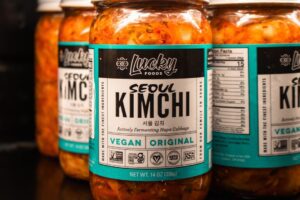
The cleanest way to get probiotics is through fermented foods rather than capsules. Live-culture yogurt, kefir, naturally fermented sauerkraut and kimchi, miso, and tempeh deliver living bacteria embedded in a food matrix that helps buffer them against stomach acid — and they bring nutrients and, in many cases, prebiotic fiber along for the ride. Kefir in particular carries a far broader range of strains than yogurt. If you want the evidence-based ranking of which probiotic foods are genuinely worth eating and which are mostly hype, the differences between them are larger than the labels suggest.
For prebiotics, the highest-value foods are not exotic. Garlic, onions, and leeks; asparagus and slightly underripe bananas; oats, barley, and legumes; and — through a quirk of food chemistry — potatoes and rice that have been cooked and then cooled, which forms resistant starch that behaves like prebiotic fiber. A practical, complete rundown of which prebiotic foods feed which bacteria is worth keeping on hand, because the goal is not to eat one super-food but to rotate through many. Diversity of fiber sources translates directly into diversity of bacteria, and diversity is the single trait most strongly associated with a healthy gut.
What About Supplements — and the Word “Synbiotic”
Supplements are not useless; they are just oversold. If you are going to buy a probiotic, the label should tell you the specific strain — genus, species, and the strain designation, like Bifidobacterium lactis BB-12 — because benefits are strain-specific and a product that lists only “Lactobacillus” is hiding the only information that matters. It should guarantee the live count (CFUs) through the end of shelf life, not merely at the time of manufacture. And it should ideally name a benefit backed by research on that exact strain. The honest question of whether probiotic supplements actually work — surviving the journey and doing what the box claims — is worth interrogating before you commit to a monthly habit.
You will also see products labeled “synbiotic.” This simply means a probiotic and a prebiotic combined in one product — bacteria plus the fiber to feed them. The logic is sound, and in principle it solves the seeds-without-fertilizer problem in a single dose. In practice, the quality varies enormously and the prebiotic amounts are often too small to matter. A bowl of oats topped with kefir is, for most people, a more reliable synbiotic than most things sold as one.
Your Action Plan: What to Do This Week
Start by feeding what you already have, because that is where the highest return sits and it costs nothing extra. For the next week, add one prebiotic-rich food to a meal you already eat — a clove of garlic in dinner, oats at breakfast, a side of cooled potato salad, half a slightly green banana. Then add a second the following week. Increase gradually: jumping from very little fiber to a great deal overnight reliably causes gas and bloating, not because anything is wrong but because your bacteria are suddenly overfed. Add roughly five grams more per week and your gut adapts smoothly.
Layer in fermented foods as a daily habit rather than a supplement. A few spoonfuls of live sauerkraut, a glass of kefir, a small bowl of yogurt with active cultures — aim for something fermented most days. This gives you probiotics in their most reliable form, food, while the prebiotic fiber you have added gives those and your resident bacteria something to eat.
Reserve actual probiotic supplements for the situations that warrant them: during and after a course of antibiotics, during a bout of infectious diarrhea, or as a targeted, strain-specific trial if you have a diagnosed condition like IBS and have discussed it with a clinician. When you do buy one, read the label for strain, CFU guarantee, and a research-backed claim — and give it a fair trial of four to six weeks before deciding whether it does anything.
If you remember nothing else, remember the ratio of effort. The bacteria are the headline, but the fiber is the story. Feed your gut and it will, quite literally, return the favor.